Is Kalshi Legal? The 50-State Tracker
Kalshi is a federally regulated exchange, and in most states everything it lists trades normally. But as of August 31, 2026, its sports event contracts are blocked by court order in three states (Nevada, Michigan, Washington), contested in a dozen more, and the Ninth and Third Circuits have now split on whether those contracts are federally protected swaps — here is the full tracker, dated and sourced.
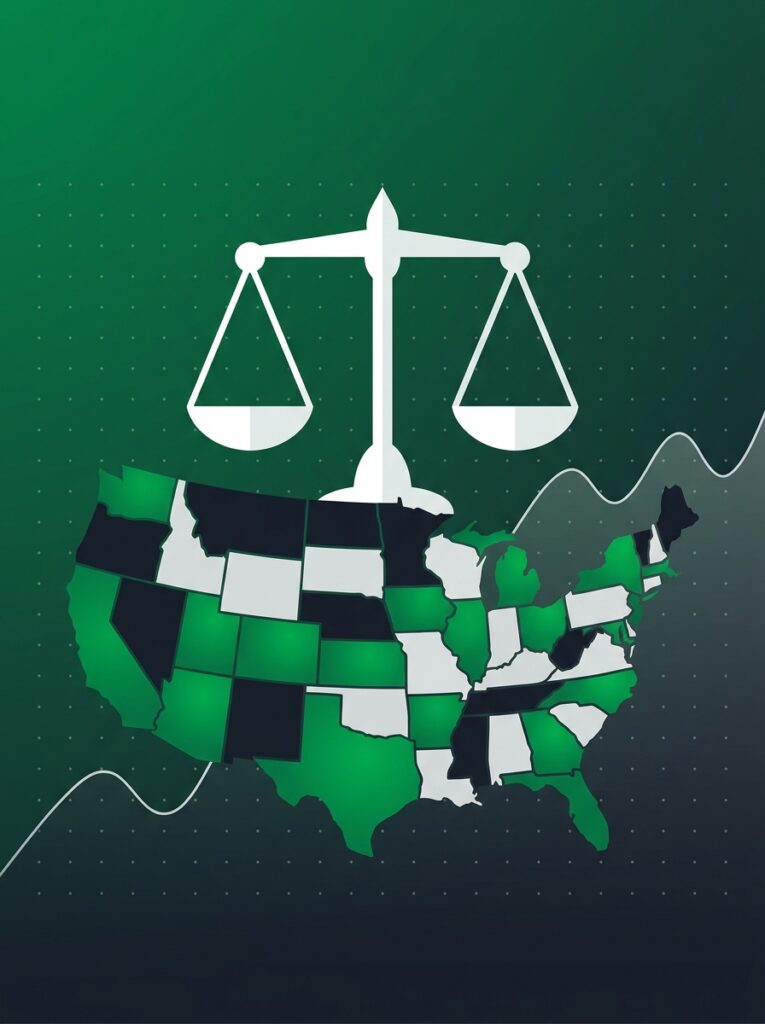
At the federal level, yes: Kalshi is a prediction market that operates as a designated contract market — a full exchange license from the Commodity Futures Trading Commission, the same regulatory category as the Chicago Mercantile Exchange — and no federal law restricts trading on it based on the state you live in. What is genuinely contested, in courtrooms in more than a dozen states as of August 2026, is narrower: whether states can apply their own gambling laws to its markets — above all one product line, sports event contracts. Three states currently have court orders keeping Kalshi’s sports markets offline: Nevada, whose order also reaches election- and entertainment-related contracts; Michigan; and, since August 13, Washington — the broadest order yet, reaching election, entertainment, culture, and tech markets too. Massachusetts won a similar order in January, but an appeals judge stayed it in February — the contracts remain available there while the state’s highest court reviews the case. New York is suing to stop the platform and collect at least $36 billion while Kalshi keeps operating there under a federal emergency order. In Utah, a federal judge ruled against Kalshi on the merits in August. In most states, Kalshi’s full slate trades normally.
This page tracks all of it: every contested state, what happened, and where it stands, with a date and a source on each line. Short answer first, then the table, then the plain-English version of the one legal question every case is actually about.
The short version, by situation
- You trade elections, economics, weather, or culture markets. With one exception, no state court order currently touches these. The exceptions are Nevada, where the state-court injunction covers election- and entertainment-related contracts alongside sports, and Washington, where an August 13, 2026 King County order reaches election, entertainment, culture, and tech markets while commodities, climate, economics, and finance may continue (NGCB; King County order, as of August 31, 2026). The one law that tried to ban prediction markets outright — Minnesota’s, which would have criminalized operating one — was blocked by a federal judge on July 27, 2026, days before it took effect (order, as of August 2026).
- You trade sports event contracts. This is the contested product. In most states there is no active dispute. Federal injunctions currently shield Kalshi’s sports markets from state enforcement in New Jersey, Tennessee, and Minnesota — and in Arizona, where the injunction was won by the federal government, not Kalshi; state court orders block them in Nevada, Michigan, and Washington; Massachusetts’ order is stayed on appeal; and New York, Maryland, Connecticut, Utah, and Ohio are contested — with Utah and Ohio having gone the state’s way so far, and Connecticut’s district rulings now leaning the same way — all as of August 31, 2026, sources in the table below.
- You’re in Nevada, Michigan, or Washington. Kalshi’s sports contracts are under standing state-court geofence orders in Nevada, Michigan, and Washington. Washington’s August 13 order required an IP/residency geofence by August 19 and a multi-source solution by September 2, and also reaches election, entertainment, culture, tech, and mentions markets (as of August 31, 2026). In Massachusetts, the January order against sports contracts is stayed on appeal, so they remain available there while the Supreme Judicial Court reviews the case.
- You’re in New York. Kalshi is live, and the state wants it stopped. A federal judge declined to shield Kalshi from state enforcement in July; the attorney general sued on July 31; the CFTC answered on August 11 with an emergency order directing Kalshi to keep operating. Nobody should tell you this one is settled.
The state-by-state tracker
Only contested states appear below. If a state is not listed, no court order or active lawsuit affects Kalshi there as of August 2026 and the full slate is available. (Several other regulators sent cease-and-desist letters in 2025 that have not become court cases; in those states there is no order to report.)
| State | The fight | Where it stands (as of August 31, 2026) |
|---|---|---|
| New Jersey | Regulators ordered Kalshi to drop sports contracts in March 2025; Kalshi sued and obtained a preliminary injunction, which the Third Circuit affirmed 2-1 on April 6, 2026, holding the contracts are likely swaps within the CFTC’s exclusive jurisdiction. | State enforcement blocked by federal injunction; New Jersey is seeking Supreme Court review — its petition deadline, twice extended, runs to September 3, 2026 (opinion; docket 25A1465). Full New Jersey page → |
| New York | The Gaming Commission ordered Kalshi to stop; Kalshi sued in federal court, and on July 7, 2026 Judge Analisa Torres denied its injunction, ruling the Commodity Exchange Act does not preempt New York’s gambling law. Attorney General Letitia James then sued Kalshi on July 31, seeking an injunction and at least $36 billion; Kalshi removed the case to federal court the same day, and the state’s motion to send it back is pending. | Contested on multiple tracks; Kalshi is operating under an August 11 CFTC emergency order while its appeal sits at the Second Circuit (ruling; NY AG; CFTC order). Full New York page → |
| Massachusetts | Attorney General Andrea Campbell sued in state court; a Suffolk County judge ruled Kalshi’s sports contracts fall under state gaming law and barred them without a license, in a ruling issued January 20, 2026. | The order was stayed on February 17, 2026 by an Appeals Court single justice pending direct review by the Supreme Judicial Court, which heard argument May 4 and has the case under advisement — sports contracts remain available in Massachusetts in the meantime (AG release). Full Massachusetts page → |
| Maryland | Kalshi sued Maryland regulators and was denied a preliminary injunction in August 2025 — the judge found Congress had not clearly displaced state authority over gambling. | On appeal at the Fourth Circuit; argued May 7, 2026, decision pending. No injunction protects Kalshi in Maryland — but counsel for the state gave written assurance in August 2025 that it will not enforce while the appeal runs (docket filing). Separately, the City of Baltimore sued Kalshi and Polymarket on August 13, 2026 under its consumer-protection ordinance — the first municipal suit in the fight — alleging unlicensed sports betting and misrepresentation, and also naming Coinbase, Robinhood, and Webull as distributors; the companies dispute the claims, and Kalshi removed its case to federal court on August 14 (No. 1:26-cv-03217, D. Md.) (as of August 31, 2026). Full Maryland page → |
| Nevada | The Gaming Control Board’s March 2025 cease-and-desist started the longest-running fight. A federal judge ruled for the state in November 2025, the Ninth Circuit declined emergency relief, and a state court issued a temporary order in March 2026, then a preliminary injunction on May 18, 2026 covering sports-, election-, and entertainment-related contracts. | Those markets are unavailable in Nevada; a July settlement set an August 12 geofencing deadline that the Board and Kalshi are now sparring over, with contempt and daily fines in play. The consolidated Ninth Circuit appeal (Kalshi, Robinhood, Crypto.com) was argued April 16, 2026. On August 28 the court affirmed in part the dissolution of Kalshi’s sports injunction — holding sports event contracts likely are not swaps, so the CEA likely does not preempt Nevada gaming law as applied to them — and remanded election contracts; unpublished dispositions the same day affirmed the Crypto.com and Robinhood denials (Nos. 25-7187, 25-7831). The ruling splits with the Third Circuit’s April 6 Flaherty decision. |
| Michigan | A state judge ruled on June 29, 2026 that Kalshi’s sports contracts are illegal sports betting, ordered certain executed trades canceled, and set an August 12 geofencing deadline backed by penalties of $500,000 a day. Kalshi moved to comply on the trade cancellations through an emergency rule change; the CFTC stayed that change on July 14, 2026 and ordered the trades honored. | Sports contracts are geofenced off for Michigan users as of August 12, 2026; the trade-cancellation piece remains a direct federal-state standoff (CFTC order). |
| Washington | The state sued, and on August 13, 2026 a King County Superior Court judge entered the broadest state-court order yet: Kalshi must stop offering sports, election, entertainment, culture, and tech markets to Washington users, with geofencing ordered — initial by August 19, full by September 2 — and $120,000-a-day penalties for noncompliance; requests to pause the order pending appeal were denied, including by a state appeals court. | Sports and most non-financial markets are coming down under a standing order; commodities, climate, economics, and finance markets may continue (report). |
| Tennessee | The Sports Wagering Council sent January 2026 cease-and-desist letters to Kalshi — and separately to Polymarket and Crypto.com; a federal judge granted Kalshi a preliminary injunction against state officials on February 19, 2026, finding Kalshi likely to succeed on its argument that the contracts are CEA swaps. | State enforcement blocked by federal injunction; Tennessee’s appeal was argued in the Sixth Circuit on July 30, 2026, consolidated with Ohio’s (docket). Full Tennessee page → |
| Arizona | The attorney general pursued enforcement, including the first criminal charges filed against a prediction-market operator (March 17, 2026). Kalshi’s own injunction request was denied in April — but on the federal government’s motion, a federal judge issued a restraining order on April 10 and a preliminary injunction on May 5, 2026, blocking enforcement of Arizona’s gambling laws against event contracts on CFTC-regulated exchanges; the district case is stayed and Arizona has appealed to the Ninth Circuit. | State enforcement blocked by a federal injunction the CFTC and DOJ won — not Kalshi, whose own motion was denied (order). Full Arizona page → |
| Minnesota | Minnesota became the first state to criminalize operating prediction markets (signed May 18, 2026; it would have taken effect August 1). The CFTC sued the next day; Kalshi and Polymarket followed. Judge Katherine Menendez blocked the law on July 27, 2026 — five days before its effective date, so it has never been enforced. | Law enjoined as a whole for CFTC-registered exchanges, not just sports, pending a merits ruling; the judge noted not every listed contract necessarily qualifies as a protected swap (order). Full Minnesota page → |
| Utah | Kalshi sued to block enforcement; on August 4, 2026, a federal judge instead granted Utah summary judgment, ruling the state’s anti-gambling law can apply to Kalshi’s sports contracts — the first merits ruling in the country, and it went the state’s way. | Kalshi is appealing; no injunction protects it in Utah (ruling report). |
| Ohio | Ohio pursued enforcement including a $5 million fine; Kalshi’s request for an injunction was denied, and on April 24, 2026 the Sixth Circuit declined to block state enforcement while the case proceeds. | State enforcement is not blocked (report). |
| Connecticut | The Department of Consumer Protection sent December 2, 2025 cease-and-desist orders to Kalshi, Robinhood, and Crypto.com; Kalshi sued, and after an early pause in enforcement, a federal judge denied its preliminary injunction on August 10, 2026 and an injunction pending appeal on August 15 — rejecting Kalshi’s argument that the CFTC’s emergency order compelled a different result. | The cease-and-desist is enforceable again. On August 19 the Second Circuit denied temporary injunctive relief pending a three-judge panel (to be heard with New York appeal No. 26-1835); Connecticut filed its full opposition August 24. On August 21 the district court entered an order on the joint motion to stay KalshiEX LLC v. Cafferelli pending that appeal. On August 26 the state sued Kalshi in Hartford Superior Court (removed the same day, D. Conn. No. 3:26-cv-01382); no court order currently takes the contracts offline. Contracts remained available as of August 31, 2026 (C&D; ruling report). Full Connecticut page → |
| Illinois | The Gaming Board sent cease-and-desist letters to Kalshi, Robinhood, and Crypto.com (April 2025) and Polymarket (January 2026); the state then enacted a licensing-and-tax law, effective July 1, 2026, that makes offering unlicensed sports event contracts a felony; the US and CFTC sued Illinois, and three federal preemption cases are consolidated before one judge. | Kalshi’s full slate is available under a written standstill — Illinois agreed not to enforce while a fully briefed injunction motion awaits a ruling, as of August 31, 2026 (IGB letters; docket). Full Illinois page → |
| KY, NM, RI, WI | Each has moved against prediction markets; the CFTC has sued all four — plus Arizona, Connecticut, Illinois, Minnesota, and New York, nine states in total — to assert exclusive federal jurisdiction. | Cases pending; no court orders currently restrict Kalshi in these four states — a federal judge denied the CFTC’s injunction request in Wisconsin on July 28 (CFTC; Wisconsin suit). |
How does one company end up legal and illegal at the same time?
Every case in that table asks the same question. The Commodity Exchange Act gives the CFTC “exclusive jurisdiction” over transactions in swaps traded on a federally designated exchange. Kalshi’s argument is a three-step syllogism: a sports event contract is a swap; Kalshi is a federally designated exchange; therefore only the CFTC — not fifty state gaming commissions — can regulate what trades there. When federal law displaces state law this way, courts call it preemption, and it is the entire ballgame.
The states attack the first premise. A contract that pays $1 if the Chiefs win is a sports bet, they argue, whatever the paperwork calls it — New York’s complaint calls Kalshi an “illegal gambling operation” that needs a state license — and regulating gambling has been state police power since before the CEA existed. Congress, on this view, does not erase that authority by implication. The states also point at the statute itself: Congress wrote a clause letting the CFTC prohibit event contracts involving “gaming,” which they read as proof that Congress knew these products might be gambling and responded by handing the CFTC a veto — not by silencing the states.
Both sides are describing the same contract; they disagree about which rulebook it lives in.
The scoreboard as of August 31, 2026: two federal appeals courts have ruled, and they split — the Third Circuit, 2-1 read the statute Kalshi’s way; the Ninth Circuit, on August 28, held Kalshi’s sports event contracts likely are not swaps and affirmed Nevada’s power to apply gaming law to them. Federal district judges in Tennessee, Arizona, and Minnesota have read it the same way. Federal judges in Maryland, Manhattan, Connecticut, Utah, and Wisconsin, and state courts in Massachusetts, Michigan, Nevada, and Washington, have read it the states’ way. Note the word “likely” running through most of these rulings: nearly everything so far is a preliminary-injunction decision — a forecast of who should win, not a final judgment that anyone has. The exception is Utah’s August 4 summary judgment, the fight’s first ruling on the merits, and it went to the state.
What is the CFTC doing about it?
Under Chairman Michael Selig, the agency has stopped acting like a referee and entered the fight as a party — consistently on the federal-jurisdiction side of the question.
- Nine lawsuits against states. The CFTC has sued Arizona, Connecticut, Illinois, Kentucky, Minnesota, New Mexico, New York, Rhode Island, and Wisconsin to defend what it describes as its exclusive authority over event contracts (CFTC; its New York complaint was filed in April 2026, months before the state sued Kalshi).
- Two emergency orders in four weeks. On July 14, 2026, it stayed Kalshi’s own rule change and ordered the exchange to honor trades a Michigan court wanted canceled. On August 11, it ordered Kalshi to keep operating despite New York’s suit, with Selig saying “New York has no business regulating these interstate financial markets.”
- A proposed rule that would draw the line. A June 10, 2026 notice of proposed rulemaking would build a formal framework for event contracts touching “enumerated activities” — gaming, war, terrorism, assassination, unlawful conduct. As proposed, it would permit sports contracts settled on objective outcomes with integrity safeguards while banning designs like injury markets, officiating markets, and anything involving pre-collegiate sports. Comments closed July 27 — and 44 state attorneys general filed one arguing the CFTC has no authority over sports prediction markets at all.
What could change next?
The Supreme Court. New Jersey is pursuing certiorari from its Third Circuit loss — Justice Alito’s filing deadline, twice extended, now runs to September 3, 2026, and the state told the Court that imminent rulings from the Fourth Circuit, the Ninth Circuit, and Massachusetts’ highest court could crystallize a clean circuit split — the Ninth Circuit has now issued, creating that split with the Third Circuit, while the Fourth Circuit and the SJC remain pending. If the Court takes the case in the term starting October 2026, a decision would likely land by mid-2027. Until then, geography decides: the same contract is federally protected in Newark and blocked in Las Vegas.
The final rule. If the CFTC adopts its proposal, sports event contracts get their first explicit federal rulebook. That would not by itself resolve preemption, but expect both sides to claim it helps them: the CFTC would point to a comprehensive federal framework, and the states’ 44-signature comment letter already reads like a preview of a challenge to the rule itself.
Congress and the midterms. Bills to restrict event contracts have been introduced, and the November 2026 elections will hand prediction markets their largest slate of election contracts since 2024 — under maximum legal scrutiny. The attorneys general bringing these suits are elected officials, and the CFTC’s aggressive posture is an administration policy; both are on the ballot in the practical sense.
Quick answers
Is Kalshi legal in the United States? At the federal level, yes — it has operated as a CFTC-designated contract market since 2020. The live disputes are about whether states can additionally apply their gambling laws, mostly to its sports contracts.
In which states are Kalshi’s sports contracts blocked right now? Nevada, Michigan, and — under an August 13 order with geofencing deadlines — Washington, as of August 31, 2026. Nevada’s order covers election and entertainment contracts, and Washington’s reaches further still (Nevada; Michigan; Washington). Massachusetts’ January order is stayed on appeal, so contracts remain available there while the SJC reviews the case. Appeals are pending in all three.
Is Kalshi legal in New York? Genuinely contested. The platform is operating under an August 11, 2026 CFTC emergency order while the state’s $36 billion suit and Kalshi’s federal appeal both proceed. As of August 2026, no one can honestly answer this with a flat yes or no.
Can I get in trouble for trading on Kalshi in a contested state? Every public enforcement action to date targets the exchange or government officials, not individual traders, and we are not aware of any state action against a user for trading on Kalshi as of August 2026. That is an observation about the record, not a guarantee about the future.
Will the Supreme Court settle this? It has been asked to. The Court usually waits for appeals courts to split; that split now exists — Third Circuit (Kalshi) versus Ninth Circuit (Nevada, Aug. 28) — with the Fourth Circuit and Massachusetts SJC still pending. If the Court grants review this fall, expect a decision by mid-2027.
Does this fight affect Polymarket and the brokers too? Yes. The Minnesota injunction covers Polymarket US, the Nevada appeal includes Robinhood and Crypto.com, and the underlying question — swap or bet — is identical for every platform listing sports event contracts.
Last verified August 31, 2026.