Kalshi vs. Polymarket: The No-Affiliate Comparison
Kalshi and Polymarket compared by a site neither one pays: regulatory footing, fees with the math, market depth, resolution failure records, and money rails — a winner named in every category, as of August 2026.

EventMarkets takes no money from Kalshi and none from Polymarket — no affiliate links, no promo codes, no paid placement. That is why this comparison can do what most “Kalshi vs. Polymarket” pages structurally cannot: name a loser in every category. Affiliate pages earn commissions when readers sign up through the winner, so there both platforms tend to win, gently, forever. Nobody pays us, so the verdicts fall where the evidence puts them.
The short version, as of August 2026: Polymarket is cheaper on almost every fee schedule and runs the deepest, broadest catalog on earth; Kalshi has the longer regulatory track record, the referee a trader never has to think about, and free dollar rails in both directions. Which one wins depends on which of those a given trader is buying. The details are below, with a scorecard at the end. Our full Kalshi review and Polymarket review both landed at 7.5/10, for almost entirely different reasons.
Which platform is on firmer legal ground?
They run different access models. Kalshi is one venue: a CFTC-designated contract market since November 2020, open in all 50 states for nearly six years. Polymarket is two: the global exchange — home of the famous election books, closed to US persons since a 2022 CFTC settlement — and Polymarket US, a regulated exchange (QCX LLC) serving Americans only since December 2025. An application to bring the global exchange onshore is pending at the CFTC, alongside a reported federal probe of Polymarket’s influencer marketing — allegations, no findings.
Neither company is safely out of the state-law war. Kalshi has borne the brunt: New York sued it on July 31 for penalties and gains the state’s petition puts at no less than $36 billion; one federal appeals court has backed its preemption defense, a Manhattan federal judge rejected it, and the CFTC has twice this summer invoked a 46-years-dormant emergency power to keep Kalshi’s markets open. As of August 2026, court orders keep its sports contracts offline in Nevada — where the order also reaches election and entertainment markets — and Michigan, per our 50-state legality tracker. And the fight now names both companies: on August 13, Baltimore sued Kalshi and Polymarket alike, alleging unlicensed sports betting under its consumer-protection ordinance — claims both dispute.
Edge: Kalshi. Six years of designated-exchange operation, one clean access model, and a federal regulator fighting to keep it open beat eight months of regulated US access — though the gap has narrowed fast, and the state-law risk is now shared.
Kalshi vs. Polymarket fees, side by side
Both charge takers — orders that execute immediately against the book — by the same style of formula: contracts × rate × price × (1 − price), which peaks at 50¢ and shrinks toward the extremes. The rates differ, and so does what makers get.
| Kalshi | Polymarket (global) | Polymarket US | |
|---|---|---|---|
| Taker rate | 0.07, all standard markets | 0.04–0.07 by category; geopolitics 0 | 0.06 flat |
| Max taker fee, 100 contracts at 50¢ | $1.75 | $1.00 (politics) – $1.75 (crypto); $0 geopolitics | $1.50 |
| Maker fee | $0 default; a listed set of series (single-game sports, economic data, awards) charges 0.0175 | Never | $0, plus a rebate paid at the point of trade (up to $0.31 per 100) |
| Maker rebates | None | 15–25% of category taker fees redistributed to makers | Point-of-trade rebate; high-volume takers earn 10–50% of fees back monthly |
As of August 2026, per Kalshi’s fee schedule (updated July 7, 2026), Polymarket’s schedule (updated July 10, 2026), and Polymarket US’s schedule (effective July 1, 2026).
Concretely: 100 contracts taken at 60¢ in a politics market cost $1.68 in fees on Kalshi, $0.96 on global Polymarket, and $1.44 on Polymarket US — and $0 on all three as a resting limit order. Two footnotes cut opposite ways: Kalshi rounds fees up to the next cent per order, taxing small orders; but its ACH funding is free, while reaching global Polymarket without crypto usually costs an on-ramp a few percent. Full math in our Kalshi fee guide and Polymarket fee guide; both venues undercut a standard sportsbook’s roughly 4.5% hold at almost every price.
Edge: Polymarket. Lower taker rates almost everywhere, a fee-free geopolitics board, makers never charged, rebates on both venues; Kalshi’s free rails and maker path narrow the gap without closing it.
Which has better markets — elections, economics, sports, culture?
Elections. Polymarket’s global election books are the deepest on earth — races anywhere, global order flow, the books journalists quote. US persons can’t trade them. Kalshi fought a federal case in 2024 to list congressional markets and now runs the deep US politics board Americans can legally reach into the November midterms. Polymarket US launched sports-first; its catalog remains a subset of the global exchange’s.
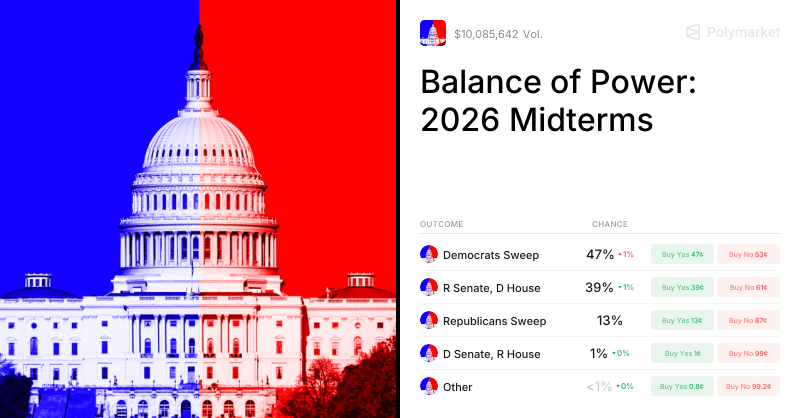
For an American, the matchup isn’t Kalshi versus the Polymarket of the headlines — it’s Kalshi versus the narrower Polymarket the CFTC has so far allowed.
Economics. Both run deep books on Fed decisions and CPI prints. Cost nuance: economics releases sit on Kalshi’s maker-fee list, while Polymarket’s economics takers pay 0.05 against Kalshi’s 0.07.
Sports. Kalshi’s core business — reportedly over 80% of volume that ran around $29 billion in June 2026, per Sacra’s estimates — with the deepest US single-game books and distribution through brokerages including Robinhood and Webull. Polymarket US is sports-led too, but newer and bumpier. The Nevada and Michigan carve-outs apply here.
Culture and everything else. Polymarket’s catalog — thousands of live questions across awards, box office, weather, geopolitics, mentions — has no real rival. Kalshi’s culture board is thinner, and it pulled sports-related mention markets in August amid a CFTC review. On both, the long tail is illiquid — wide spreads, token depth — so the order book, not the headline price, is the product.
Edge: Polymarket — with the asterisk that decides real choices: among venues a US trader can actually access, Kalshi’s catalog and depth win today.
Whose resolution process fails less badly?
Both have settled markets wrongly enough to make news; the failures differ in kind. Kalshi is its own referee under a CFTC-filed rulebook, and that discretion misfired in February 2026, when it settled a roughly $54 million Khamenei market at the pre-news price under a death carveout. The fixes were real — the rule is now codified, and Kalshi refunds trading fees on disputed settlements — but there is still no independent arbiter.
Global Polymarket outsources the call to UMA’s optimistic oracle, where disputes end in a token-holder vote. Its record is the industry’s most documented: a Ukraine minerals market that resolved yes in March 2025 with no deal in existence; a Wall Street Journal investigation finding conflicted voters in nearly 20% of the disputes it reviewed; a roughly $60 million Strategy market in June 2026 resolved against the plain reading of events. Whitelisted proposers have cleaned up routine cases since late 2025, but contested calls still end in a token vote. In short: Kalshi’s referee has discretion it has misused; Polymarket’s has conflicts it hasn’t engineered away. Polymarket US resolves under an exchange rulebook with regulatory recourse — on this axis it sits on Kalshi’s side of the ledger.
Edge: Kalshi. A regulated referee that had to be pressured into better process still beats a crowd of pseudonymous token holders, some with money on the game.
Deposits and withdrawals: dollars vs. USDC
Kalshi is dollar-native: $10 minimum, free ACH in both directions (up to five business days), instant debit deposits at up to 2%, plus wire, RTP, and USDC rails, with no settlement fees. Its known weakness is friction, not safety — recurring complaints about slow verification and hard-to-reach support, with customer funds in CFTC-mandated segregated accounts throughout. Global Polymarket runs on USDC on Polygon: gasless trading and free, near-instant withdrawals, but funding means acquiring a stablecoin — on-ramps take a few percent — and custody is a smart contract, uninsured. Polymarket US takes ordinary dollars through a CFTC-registered clearinghouse, at the price of the narrower catalog.
Edge: Kalshi. For anyone starting from a bank account, free rails both ways and segregated dollar custody win; crypto-native traders will reasonably flip this category.
Data and tools
Kalshi built for traders: a public API with websocket feeds, a real algorithmic ecosystem, and Kalshi Pro, the terminal-grade product shipped in July. Polymarket built in public: the category’s best interface and a global exchange whose every trade is visible on-chain. That transparency has teeth — when Bloomberg examined potential insider trading in August 2026, it could analyze roughly 34,000 flagged Polymarket trades directly on the blockchain, an audit no outsider can run on Kalshi’s closed book.
Edge: Polymarket, narrowly — best-in-class interface plus radically public data. Heavy multi-market traders will find more terminal in Kalshi Pro.
The scorecard, and who each platform is for
| Category | Edge | In one line |
|---|---|---|
| Regulatory footing | Kalshi | Six years as a designated exchange vs. eight months of regulated US access |
| Fees | Polymarket | Lower taker rates almost everywhere; makers never pay, and get rebates |
| Variety & depth | Polymarket* | Deepest catalog on earth — *but Kalshi wins among US-accessible venues |
| Resolution | Kalshi | A regulated rulebook beats a token vote with documented conflicts |
| Money rails | Kalshi | Free ACH both directions and segregated dollar custody |
| Data & tools | Polymarket | The category’s best interface, and fully public order flow |
Three to three, and that’s not a dodge — it’s the finding. These are different machines, and the tie breaks on what a trader does. A US sports or elections trader is better served by Kalshi: depth, legal access, dollar rails, with the two-state sports carve-out priced in. A non-US or crypto-native trader is better served by global Polymarket: bigger catalog, lower fees, rails that match how they already hold money. A trader who prizes never thinking about the referee belongs on the rulebook venues — Kalshi or Polymarket US — and should treat the oracle discount on global Polymarket as real. And cost-obsessed traders learn the same lesson everywhere: resting limit orders trade free on both platforms. None of that is a recommendation to open an account; it’s what the evidence prices.
Which platform do you actually trade?
Community poll — not a prediction market, not financial advice.
Quick answers
Which has lower fees, Kalshi or Polymarket? Polymarket, on the schedules: taker rates of 0.04–0.05 in most categories (geopolitics free) against Kalshi’s flat 0.07, with Polymarket US at 0.06; makers trade free on both platforms. Kalshi claws back ground with free ACH funding, while global Polymarket usually costs an on-ramp fee to reach. As of August 2026.
Which is safer, Kalshi or Polymarket? Depends on the risk. For custody and disputes, the regulated venues — Kalshi and Polymarket US — hold funds in segregated accounts or a registered clearinghouse and resolve under CFTC-filed rulebooks; global Polymarket holds USDC in smart contracts, uninsured, and settles disputes by token vote, its documented weak point. Neither has lost customer funds, and both face state and city suits over sports contracts, tracked in our legality tracker.
Which is better for elections? For US persons, Kalshi — its election markets are deep, federal-court-tested, and legally accessible. Polymarket’s global election books are the world’s deepest but remain closed to Americans; its pending CFTC application could change that answer, and this page will be updated if it does.
Can a trader use both? Where eligible, yes — and price differences between them on similar questions are themselves information. Accounts generate separate tax paperwork; see our prediction-market tax guide.
Do the platforms pay for this comparison? No. EventMarkets takes no affiliate, sponsorship, or other compensation from any platform it covers — which is why the categories above are allowed to have losers.